Mathematical Strategies & Psychology Behind the World's Most Deceptive Game
Everyone knows Rock Paper Scissors, but few realize there's serious mathematics behind winning consistently. Discover the game theory, psychology patterns, and algorithmic strategies that can give you a statistical edge.
Always playing the same move is mathematically terrible with a 0% expected win rate against any competent opponent.
Play each move with specific probabilities to remain unpredictable while exploiting opponent patterns.
The optimal strategy: Play Rock, Paper, and Scissors each exactly 1/3 of the time (33.33%).
| Rock | Paper | Scissors | |
|---|---|---|---|
| Rock | 0 | -1 | +1 |
| Paper | +1 | 0 | -1 |
| Scissors | -1 | +1 | 0 |
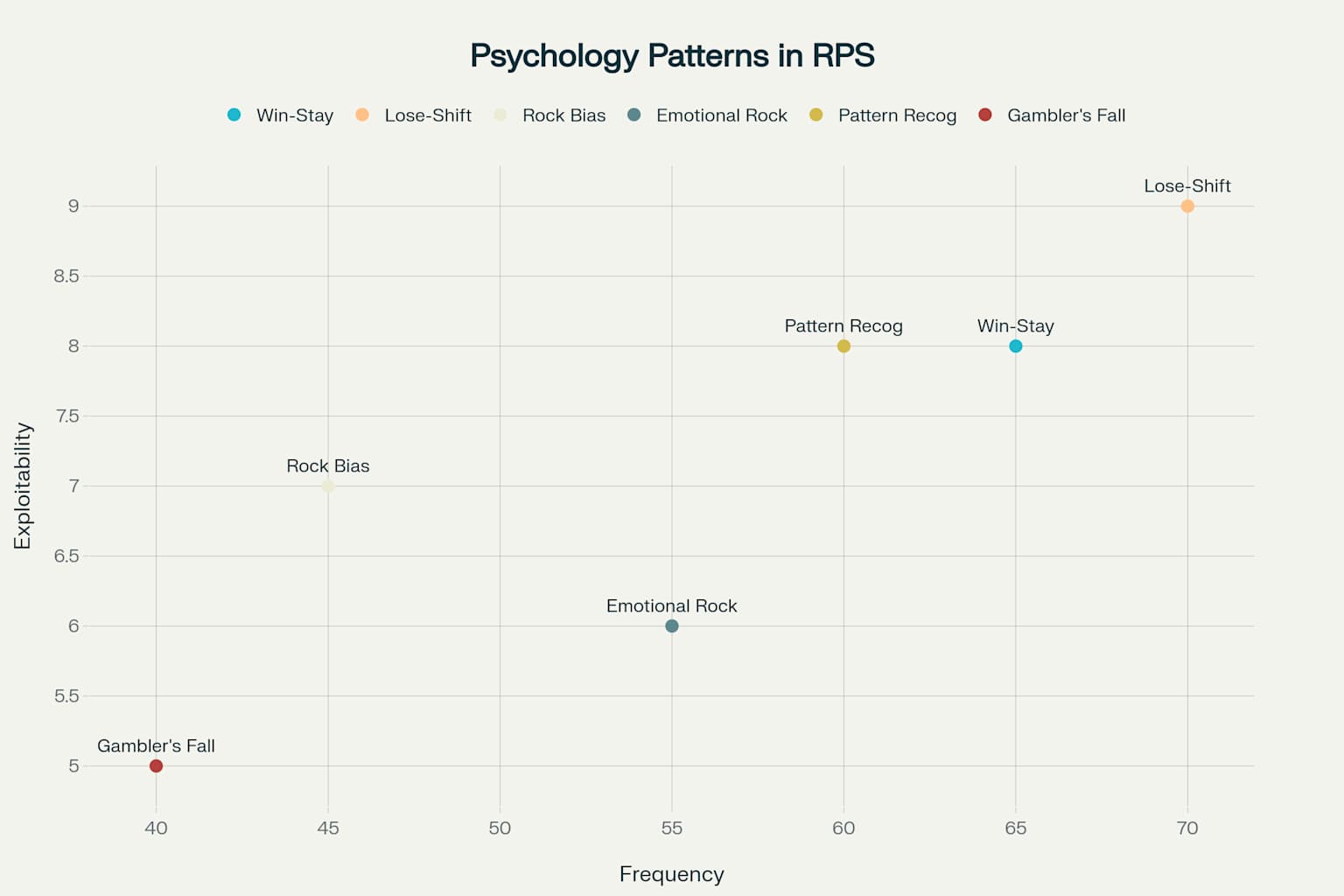
Humans are terrible at being random. Here are the most exploitable psychological patterns:
Winners tend to repeat their winning move. Exploitability: 8/10
Losers change their strategy after losing. Exploitability: 9/10
Beginners favor Rock as the first move. Exploitability: 7/10
Frustrated players default to Rock (aggressive). Exploitability: 6/10
Test your skills against different mathematical strategies. Can you beat the algorithms?
See how predictable you are and what patterns the AI has detected in your play.
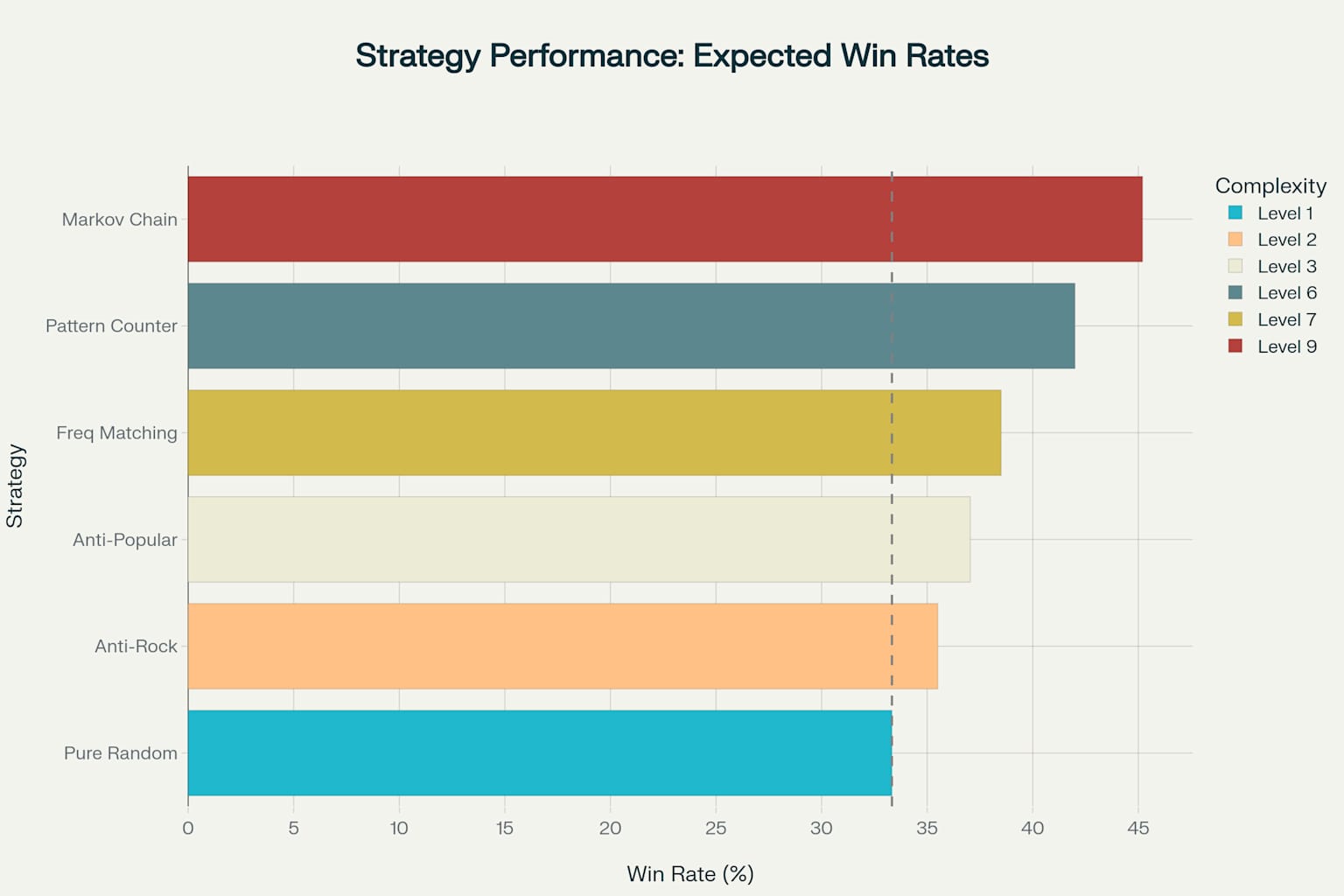
Run thousands of games to see how different strategies perform against each other.
Predicts next moves based on sequences of previous moves using transition probabilities.
Adapts to opponent's move frequencies over time, countering their most common choices.
Detects and exploits repeated sequences in opponent play using n-gram analysis.
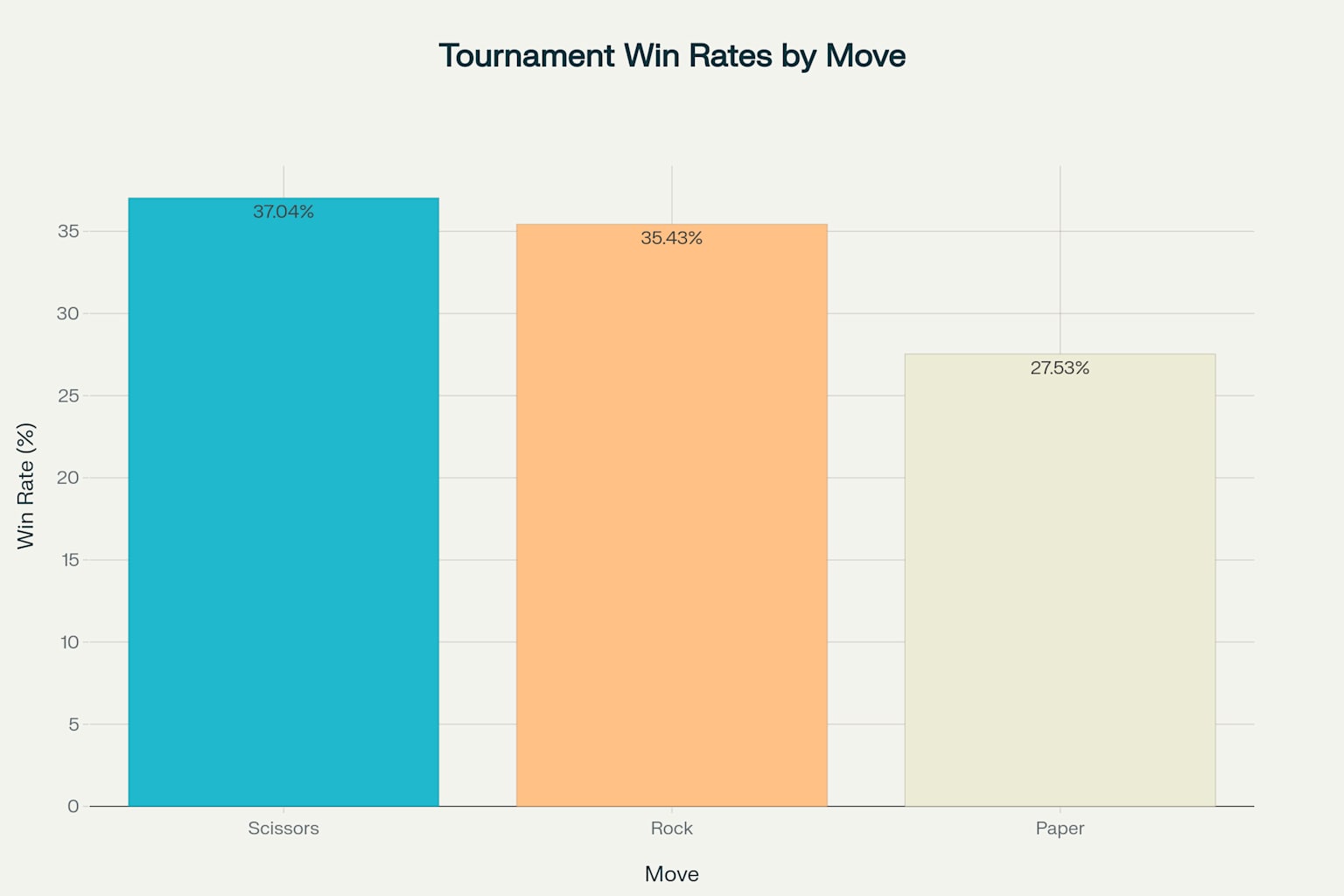
Analysis of professional Rock Paper Scissors tournaments shows these surprising statistics:
Remember: The best strategy depends on your opponent. Against random players, stick to Nash equilibrium. Against humans, exploit their psychological patterns. The mathematics gives you the edge, but psychology wins the game.